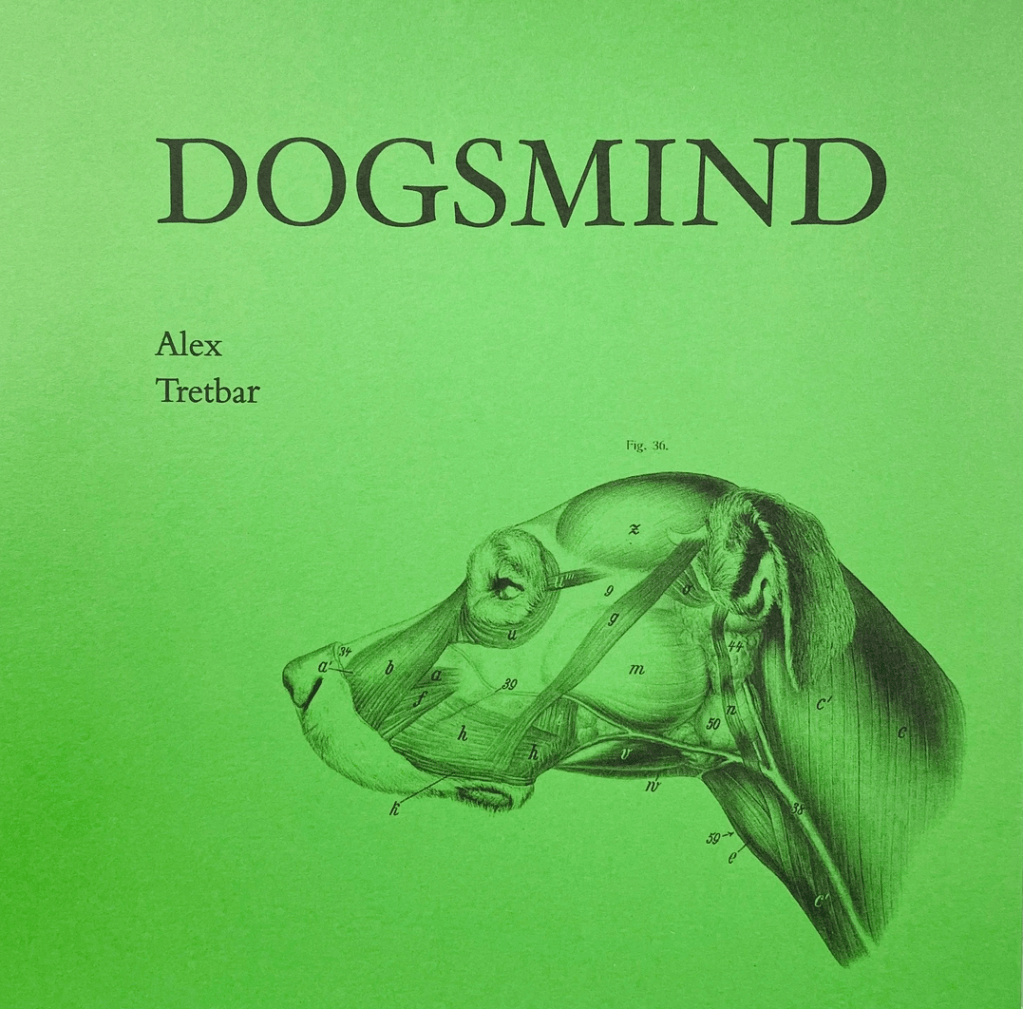
Dogsmind (Dead Mall Press, 2026)
Dogsmind is a poem-novella ouroboros without ending or beginning. It digests techniques and motifs from Joyce’s Ulysses to render a freakish beauty from its tech-addled, hallucinatory tale of friendship, betrayal, addiction, and death. Trapped between doom and hilarity, its narrative of The Spokesperson/“I”, Ripjohn, The Requestor, and Patches plays out alongside a personified and lethal History who reminds us, “I am also tomorrow.” Somewhere in the center of this labyrinth, we find a freezing dog suffering the technologies of empire who implants a desire in “I” to speak for those History would erase. But in this book’s ever-repeating nightmare, the very conditions of speech become inseparable from madness.
+++
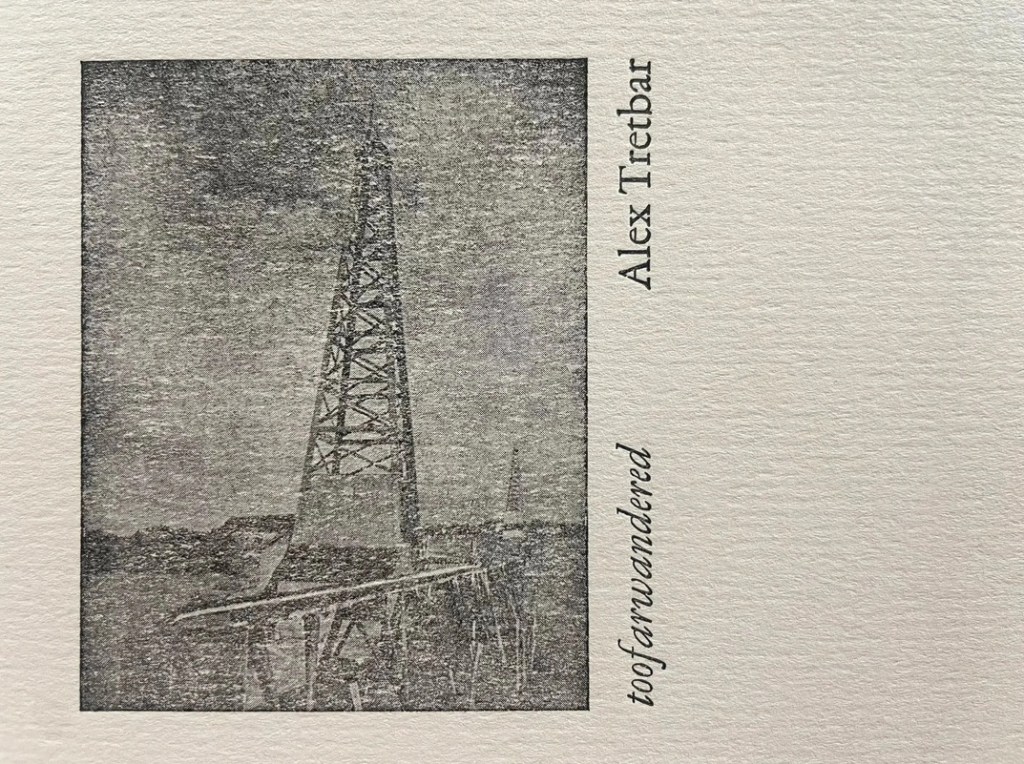
toofarwandered (Tilted House, 2026)
(Editor’s Choice, 2025 1BR/3BATH Chapbook Prize)
A malfunctioning consciousness proceeds through its fabular bootup protocol as it prepares to enter (or exit) (or continue to exist forever in) hell. A mutatedlanguage-voice looks back on its myriad potholes and occasional flowers with curiosity, hope, and horror. The brain runs out of money but keeps on running anyway. An ur-myth in dense miniature, toofarwandered is a technical document for systemic failure and perpetual self-[un]fashioning.
“Alex Tretbar’s toofarwandered beheads the meadow of the page by resisting the human urge to possess and, in turn, be possessed by language. The ecstasy of this book, for me, comes most obviously from its tremendous inventions for the problems of speaking— specific problems that I had not yet considered. The speaker of toofarwandered alchemizes, through sound, the anxiety of physicality into the real, thumping, bloody organs of a more precise movement. As the techy-metrics of the poems die out, their ghosts sow and haunt a more wild organic word. It makes me feel like the Greek god Janus, looking forward and back on a swatch of grass-turned-sod, night-vision-green, attempting to locate the nowhereness of what it is we ‘do’. Now more than ever, I feel enchanted by Tretbar’s vision of poetry as a ‘gross harmony’. Like the retina burn of a lunar eclipse, its vulgarity is inseparable from its witness-in-totality.”
—Ellen Boyette, author of Local Virgin of Impression
“to read toofarwandered is to fostivate a massive pleasure salvagely.
this is an opportunity to really listen to the trumpetleaves
and experience the harmonic asmr of tallahassean clavierery.
financially and larynxly speaking, you simply cannot afford not
to graffiti down a commitment to read this chap.
Tretbar has gifted us this chamber of labyrinths of
portaling insurgency. and so, you gotta let the rats and moths
telegram you inside.”
—Jenkin Benson, author of are we rocking with this?
+++
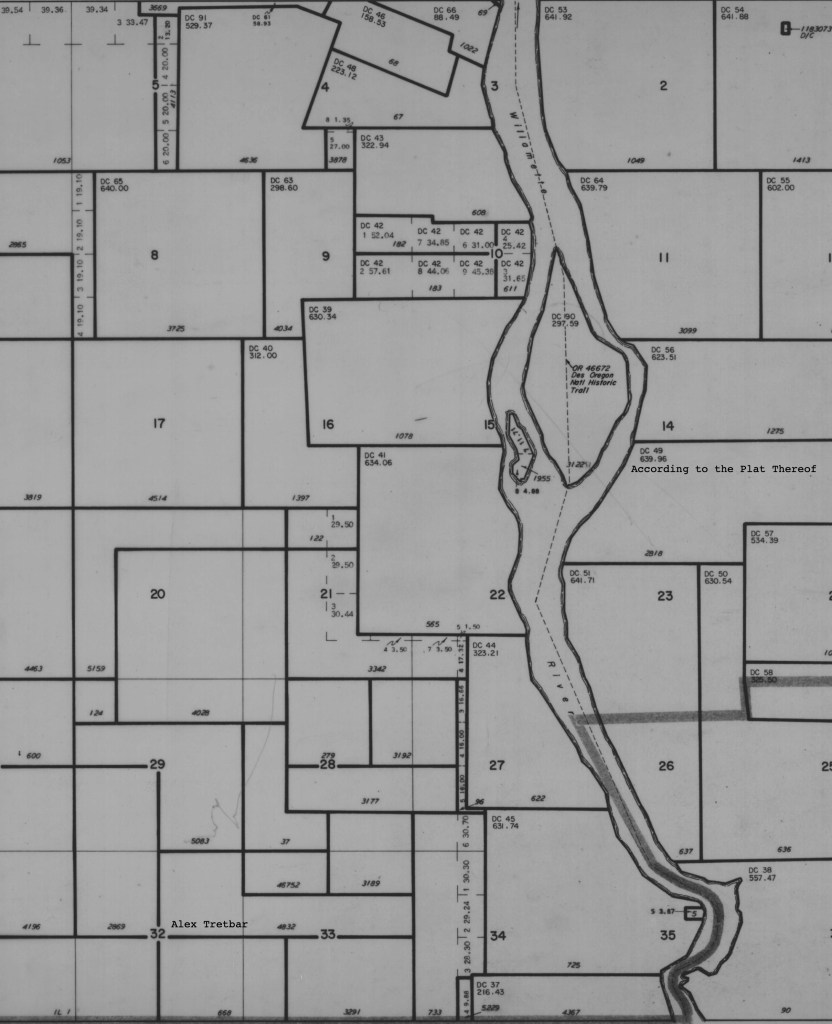
According to the Plat Thereof (Ethel, 2025)
According to the Plat Thereof is interested in bodies, names, and the spaces through which they circulate. The construct of “the speaker of the poem” becomes a vehicle for discovery, body-swap, escape, and voyage. Jagged sonnets compete with and interrupt themselves. Urban and pharmaceutical design intersect beneath the same stoplight. “Unbodied” poems sit blankly beneath the titles that designate them like usernames. In the face of institutional exhaustion, the voice toggles between presence and vanishment. Like the plat of the book’s title, the speakers of these poems are cartographical.
“Titles, like frames, occupy a space that is at once part of the piece and outside it, which is another way of saying that titles are the edge at which the story meets the world. For most written works, titles are all one ever sees of them, the rest of the work remaining concealed behind a book cover or beneath the white space that serves to separate title from work. They are both outside the work and the outside of the work, separate from it and fundamental to our perception of it. Other parts of a work can be attributed, variously, to characters or speakers or narrators, but who speaks the title?
These six unbodied poems—one of which is titleless—take advantage, in what I want to call a Holzerian fashion, of the nonspace of the title, a voice that comes from nowhere and no one and is therefore impossible to ignore. They are, of course, a lot of fun.”
—Always Crashing, on the “unbodied” poems of According to the Plat Thereof
+++
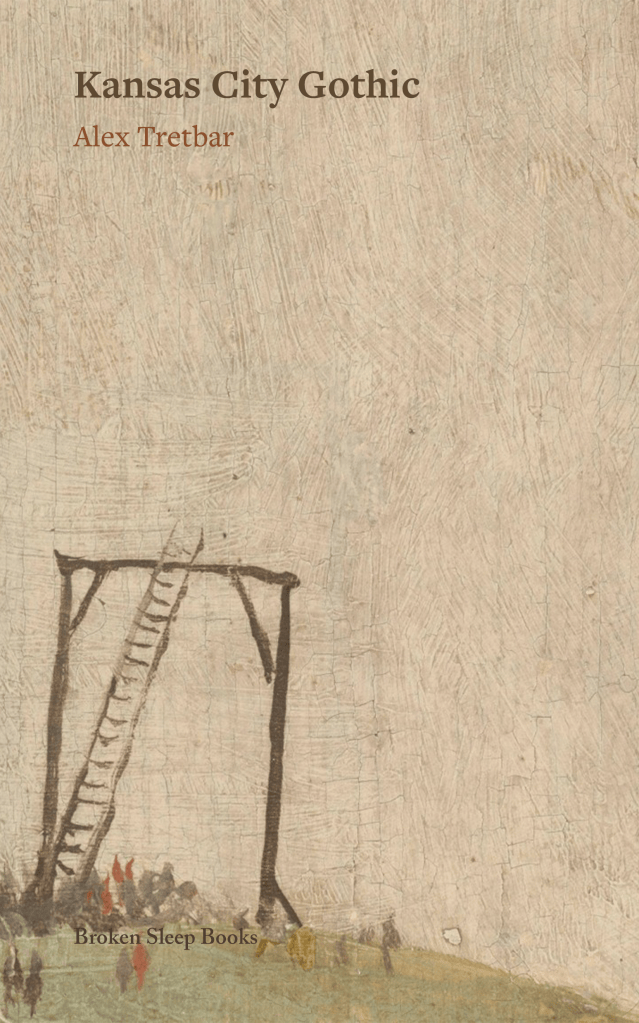
Kansas City Gothic (Broken Sleep, 2025)
Kansas City Gothic is a hallucinatory, incantatory fugue of incarceration, addiction, and survival, written in jagged, recursive fragments that chart a psychic and political topography of the American Midwest. Structured around alternating ‘movements’ and ‘codas’, the collection draws from jazz, liturgy, and urban decay to form a syntax of rupture and return. Tretbar’s lines are elliptical, layered with allusion, attuned to the rhythms of memory and trauma. Across spaces of incarceration, punk houses, hospice beds, and poisoned landscapes, the voice moves with stark intimacy and formal invention. The result is a darkly luminous reckoning with violence, recovery, and the unstable ground between personhood and place.
“Alex Tretbar’s Kansas City Gothic simultaneously maps bodies full of hunger, full of longing, while engaging slyly and philosophically with enclosures and landscapes. Where at first the bodies feel either trapped in the carceral establishment or within their own addictive impulses, soon—through language—they give way to varied sites of being and creation. This preternatural legerdemain is accomplished through deft verbal dexterity that lives in form and breaks form. Outward hunger manifests and—ouroboros-like—turns back: “I saw in the concave calcium mirror / that I had become my own food / supply, self-cannibal: / a lidless eye of only pupil.” The magic of this poetry reaches beyond the speaker’s dense meditations on self to include engagements with others on the fringes, where the “you” proliferates to “represent three / or more discrete dead friends” as another speaker asks “what physical changes can I expect / to see when nearing death in the shadow / of dwarf ’s owl clover and spruce”; here is a fierce ideological critique of America that is both fugue and toccata, where the poet holds up fractured mirrors to the self and the world. I have read nothing like Tretbar, nothing that combines the body politic with the body aesthetic. Kansas City Gothic is the beginning of a singular new voice in contemporary poetry.”
—Charles Kell
“In musical notation, a coda designates the final part of a piece. ‘But there is
no finality here,’ I thought as Alex Tretbar’s Kansas City Gothic devoured me. Music came to mind repeatedly: music and memory fashioned with an unrelenting, brilliant intensity. From the dialectic energy of the titling to his conceptual engagement of the Great American Songbook, Tretbar startles and stuns. He lyricizes the line break’s relation to time. He calls us into the aural texture of the carceral phone call—“the silence would just elongate, distend”—and blazes the contrast between “fast-food” and waiting for drugs or deliverance. Images strike the eye and ear simultaneously, as with the “cornflower blue I remember” and the use of reverse anaphora. The book you are holding contains one of the best sonnet coronas I’ve ever read; its flowers still shimmer and take up space in the crannies of my head. I can hear them, just as I hear Kansas City, the plains narrowing the horizon and marking the spaces where “every hello” is “preauthorized,” packaged
by U.S. socialization, for the given material world includes the commodified
emptiness that shines at its center. Tretbar’s critique of carceral systems feels
almost Proustian: it is built into the alternating structure between “Movement” and “Coda,” redbricked into the longing for home, justice, and hope. There are so many ways to be destroyed by late capitalism. Tretbar’s poems admit this. Yet they resist all foregone conclusiveness in their insistent use of the lyric to reimagine hope and possibility. The stories we tell, the music (and muses) of self-narration, the treasured spaces kept secret in the landscapes which shaped us: all meet in these extraordinary pieces and poems. Truly astonished by the skill of these poems, and how intimately Tretbar’s hand knows the lyre it holds.”
—Alina Stefanescu
+++

